
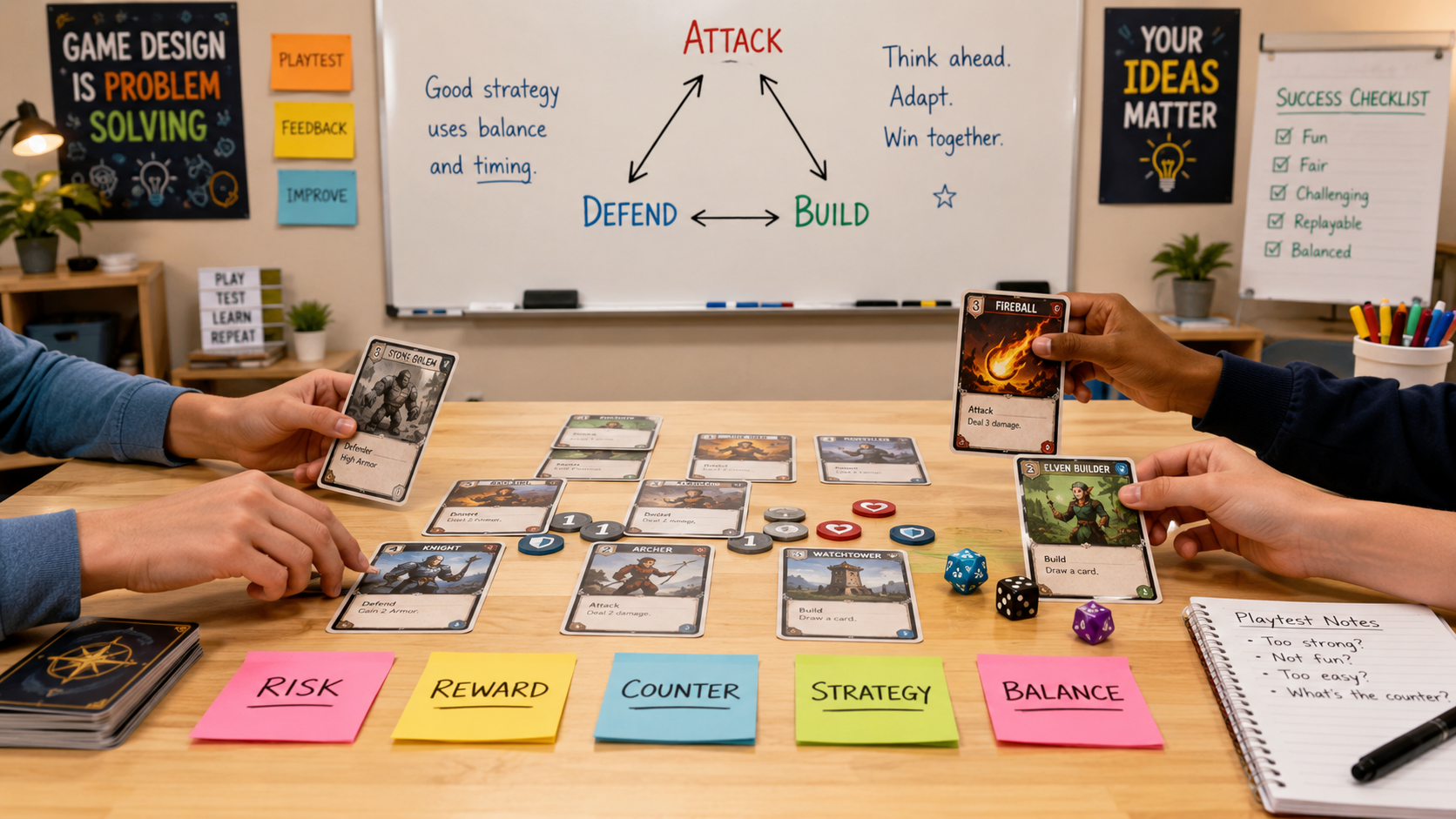
Strategic Game Design & Computational Thinking
A 6-8-week design studio where students build strategic card games while learning systems thinking, math, algorithms, and critical reasoning.
What Students Create
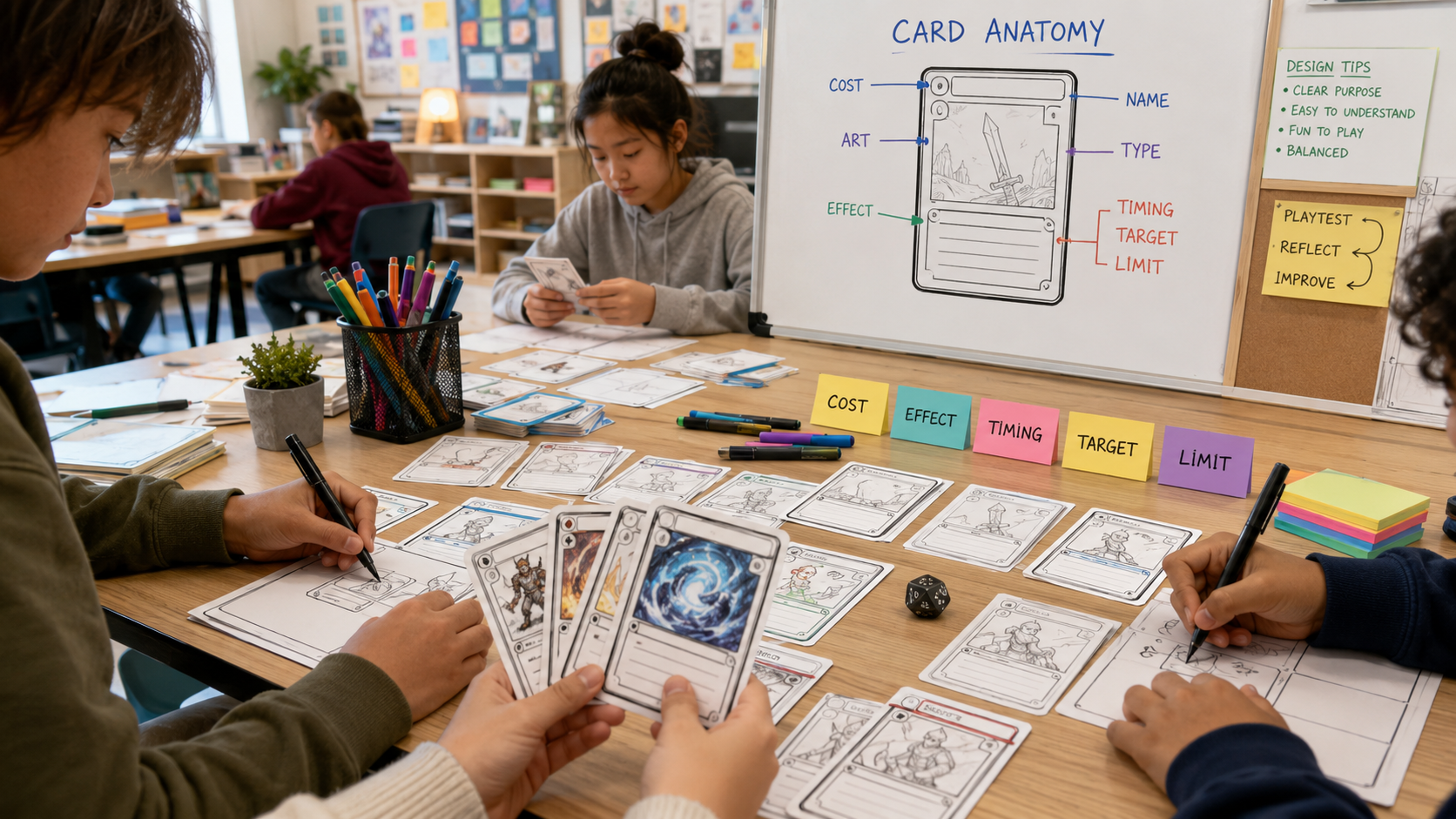
Students create their own playable strategic card games similar to Magic The Gathering, and Pokemon Card games.
-
Students design and build their own playable card games from the ground up, including the theme, game objective, player actions, resources, card types, and overall gameplay experience.
-
Students write clear rulebooks that explain how the game is set up, how turns work, what players can do, how resources are used, and how a player wins. This helps students practice clarity, sequencing, logic, and communication.
-
Students create custom card sets with meaningful abilities, resource costs, strengths, weaknesses, and limitations. They learn how to prevent overpowered cards by designing trade-offs, counters, and balanced interactions.
-
Students document how their game works as a system. They map how rules, resources, cards, strategies, and player decisions connect, while building a design portfolio that shows their thinking, revisions, and creative process.
-
Students test their games with peers, collect feedback, identify problems, and make improvements based on evidence. At the end of the program, they present their final game and explain the strategy, math, logic, and design decisions behind it.
What Students Learn
Skill Development Outcomes — they design, analyze, balance, test, and present complete game systems. Such as Magic The Gathering, and Pokemon
-
Students develop the ability to evaluate choices, compare trade-offs, predict consequences, and justify decisions. They learn to identify weak points in a system, recognize dominant strategies, and improve designs through evidence-based reasoning.
-
Students build practical math skills by using probability, ratios, percentages, cost curves, and balance comparisons to improve gameplay. They learn how to use numbers to analyze fairness, efficiency, randomness, pacing, and strategy.
-
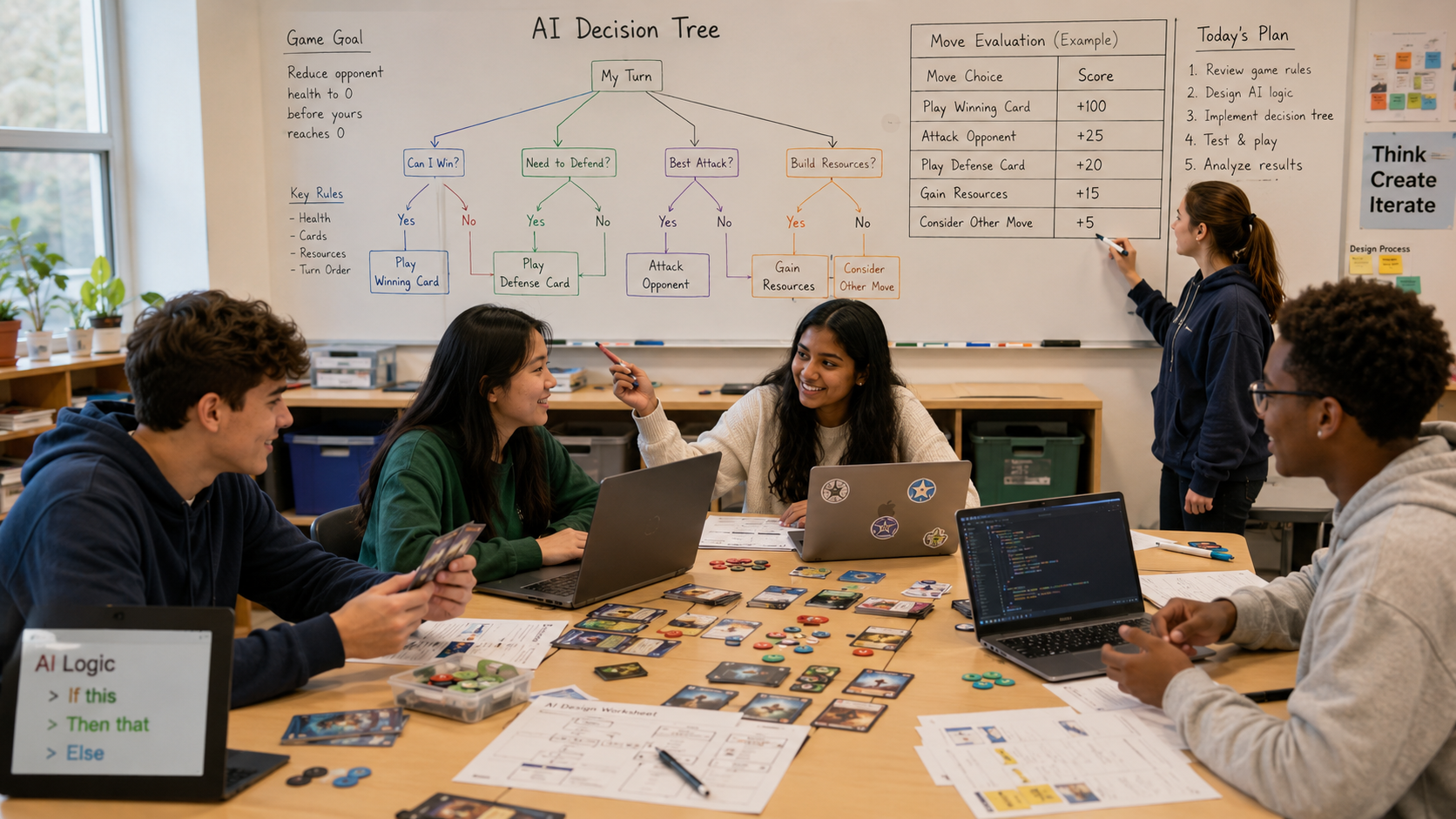
Students strengthen computational thinking by breaking systems into steps, identifying variables, creating flowcharts, writing IF/THEN logic, debugging rules, and understanding how simple AI decision-making works.
-
Students practice teamwork through peer critique, playtesting, group problem-solving, and design discussions. They build skills in explaining ideas clearly, giving constructive feedback, listening to others, and presenting their work with confidence.
-
Students develop creative confidence by turning ideas into structured, playable systems. They learn to design rules, cards, mechanics, themes, strategies, and player experiences that can be tested, improved, and shared with others.
-
Students learn how to use feedback, observation, and playtest data to revise their work. They build resilience by understanding that strong designs are developed through testing, reflection, and continuous improvement.
The D.R.A.F.T. Design Studio Method
Research the system
Define the design problem
Apply a design tool
Fix, Test, and Iterate
Tell the design story

Program Pathways
Foundations of Game Design & Critical Thinking
The Beginner Level is designed for students who are new to strategy game design, systems thinking, and computational thinking.
Recommended Student Profile
Students should be:
Grades 6 and above
Interested in games, creativity, strategy, design, or problem-solving
Comfortable working with peers in small groups
Willing to draw, write, test ideas, revise, and present their work
Able to follow multi-step instructions with instructor support
No Prior Experience Required
Students do not need prior experience with:
Pokémon
Magic: The Gathering
programming
advanced math
game design
probability
Helpful Readiness Skills
Students should be able to:
Read and write short explanations
Do basic arithmetic
Understand simple fractions or percentages with support
Participate in discussion
Give and receive feedback respectfully
Stay engaged in a project over several weeks
Advanced Systems Design, Strategy & Computational Game Engineering
The Advanced Level is designed for students who are ready for deeper systems analysis, math modeling, algorithms, programming logic, and technical design.
Recommended Student Profile
Students should be:
Grades 8 and above, or younger students with strong readiness
Comfortable with multi-step projects
Interested in strategy games, programming, math, AI, game design, or systems engineering
Able to work independently and collaboratively
Willing to analyze, test, revise, and defend design decisions
Recommended Prerequisite
Students should ideally have one of the following:
Completed the Beginner Level program
orPrior experience with strategy card games, coding, robotics, math enrichment, game design, or advanced project-based learning
Helpful Readiness Skills
Students should be able to:
Understand ratios, percentages, and basic probability
Follow logical sequences and multi-step instructions
Work with tables, charts, or spreadsheets
Write short technical explanations
Think abstractly about systems, variables, and cause/effect
Participate in structured critique and playtesting
Persist through debugging and revision
Recommended Technical Readiness
Students do not need to be expert programmers, but they should be ready to learn concepts such as:
Algorithms ,Variables, Game state, Events and triggers
Data structures, expected value, Simulation
AI decision logic
Programming may be done through:
pseudocode, spreadsheets, Scratch or block coding
Python-lite example, no-code/manual simulations
Past Project
The Atlas Project
A bold reimagining of a timeless brand.


Let’s Work TogetherIf you're interested in working with us, complete the form with a few details about your project. We'll review your message and get back to you within 48 hours.